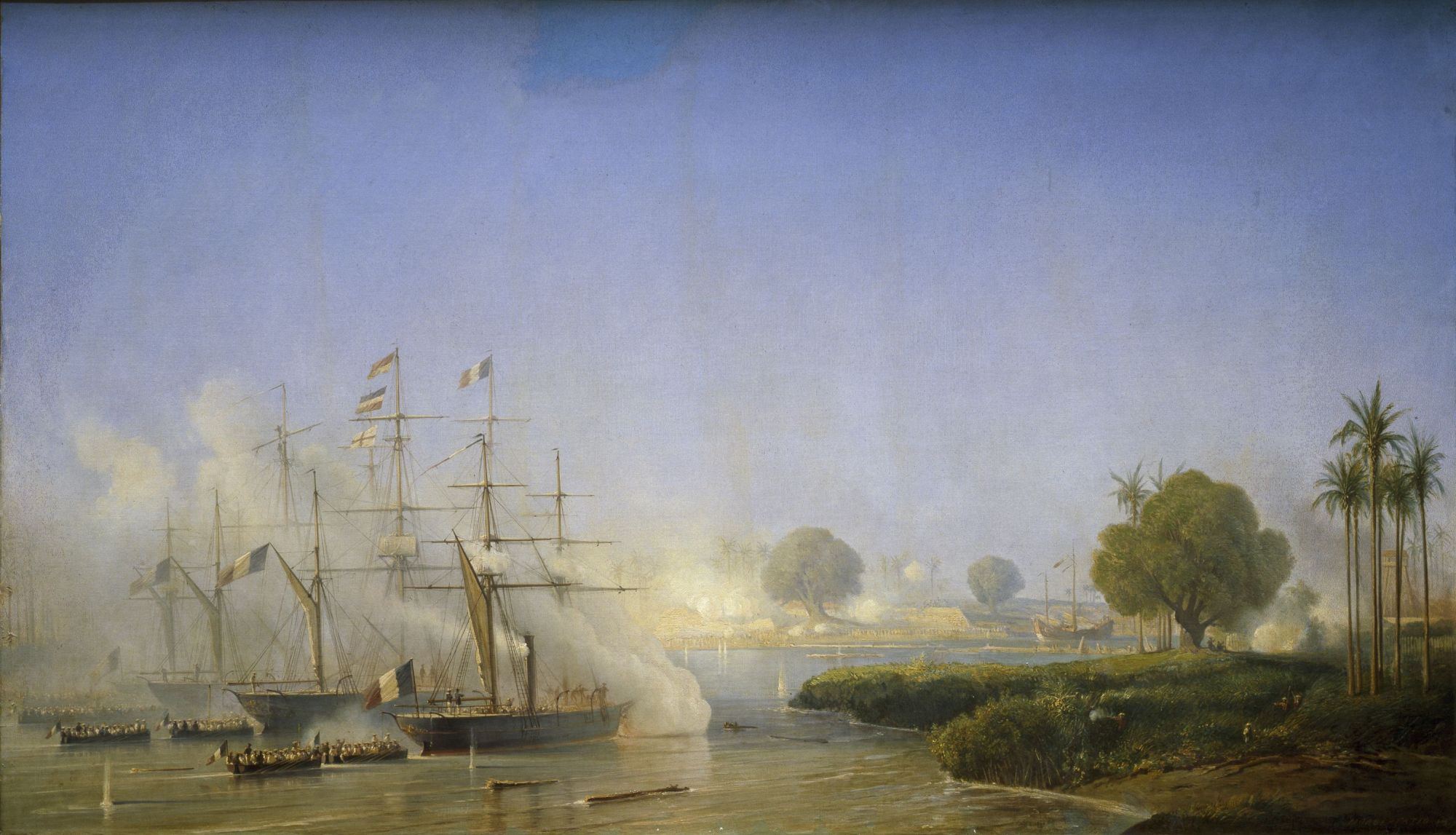
Painting of the French naval assault on Saigon, 1859, by Antoine Léon Morel-Fatio

Eighty-Seven Years · 1858 to 1945

Colony, Resistance
and Revolution

How French colonial rule transformed Vietnam and fuelled the rise of modern nationalism and the struggle for independence

A virtual museum in seven exhibits

A note from the curator

Welcome to this exhibition. As a historian and curator, I have designed these seven exhibits to investigate the period of French colonial rule in Vietnam and to explain how colonialism created the conditions for Vietnamese nationalism and the eventual struggle for independence.

The exhibition traces the political, economic, social and cultural transformation of Vietnam under French control from 1858, and shows how these changes generated growing opposition that culminated in the August Revolution of 1945.

Please move through the exhibits in order. Each exhibit contains carefully selected primary and secondary sources that have been evaluated for their usefulness in this inquiry.

HANOÏ · TONKININDOCHINE2 SEPT1945

About this Exhibition

About this Exhibition

How did French colonial rule transform Vietnam and contribute to the development of Vietnamese nationalism and the struggle for independence?

French conquest began in 1858 and gradually brought the whole of Vietnam under colonial control. French rule fundamentally reshaped Vietnamese politics, the economy, society and culture. These transformations produced deep grievances and new forms of political organisation that turned traditional resistance into modern nationalism.

This exhibition investigates that process. It focuses on the colonial period (1858–1945) and shows how colonialism itself created the conditions for revolution.

Emperor Khai Dinh in Hue, 1923
Annam1923
Portrait of Phan Boi Chau, 1926
Phan Bội Châu1926
Ho Chi Minh reading the Declaration of Independence, 2 September 1945
Ba Đình1945
Portrait of Emperor Bao Dai
Bảo Đại1932
HUÉ · ANNAM9 OCT1924
SAÏGON · COCHINCHINE18 FÉV1859

Floor Plan

The seven exhibits follow a chronological and causal path. This is the order you will walk them in.

Exhibit 1Conquest and Control
01
02
03
04
05
06
07

When you're ready, start scrolling to visit the first exhibit.

Each exhibit includes primary and secondary sources. These sources have been evaluated for their origin, purpose, value and limitations in answering the exhibition's central question. A full bibliography appears on the final page.

Exhibit 01 of 07
Cochinchine1859
Exhibit01

Conquest and Control: France Takes Vietnam

1858 — 1897

A naval attack at Đà Nẵng expands into full colonial control. Cochinchina annexed, protectorates over Annam and Tonkin, the Indochinese Union formed in 1887.

Go to Exhibit One
Hué · Annam1924
Exhibit02

Political Transformation: Colonial Administration and the Loss of Sovereignty

1887 — 1919

The Confucian examination system abolished, the emperor reduced to a symbol, French Résidents holding real power.

Go to Exhibit Two
Suzannah1919
Exhibit03

Economic Exploitation: Land, Rice, Rubber and Taxation

1890s — 1930s

Fertile land alienated for French plantations, forced labour, and state monopolies on salt, alcohol and opium.

Go to Exhibit Three
Hanoï · Tonkin1884
Exhibit04

Social and Cultural Change: Education, Religion and Identity

1900s — 1940s

A small francophone elite emerges while the majority stay excluded. Catholicism expands, Confucian hierarchy erodes.

Go to Exhibit Four
Yên Thế1890s
Exhibit05

Early Resistance and the Birth of Modern Nationalism

1885 — 1925

The Cần Vương movement, then Phan Bội Châu and Phan Châu Trinh turn anti-French feeling into modern political ideology.

Go to Exhibit Five
Tours · France1920
Exhibit06

Ho Chi Minh and Organised Anti-Colonial Nationalism

1911 — 1941

Independence fused with social revolution. The Indochinese Communist Party in 1930, the Việt Minh in 1941.

Go to Exhibit Six
Ba Đình · Hanoi1945
Exhibit07

From Colony to Revolution: The August Revolution and the Declaration of Independence

1940 — 1945

Japanese occupation, famine, then the seizure of Hanoi and the Declaration of Independence.

Go to Exhibit Seven
Exhibit 1 of 7
The French assault on Saigon, 1859
Saïgon1859
Engraving of the capture of the Saigon citadel, 1859
Citadelle1859
Exhibit01

“For more than eighty years, the French imperialists, in the name of Liberty, Equality, and Fraternity, have violated our Fatherland and oppressed our fellow citizens.”Declaration of Independence · 2 September 1945

Conquest and Control: France Takes Vietnam

1858 – 1897

In 1858 French naval forces attacked the port of Đà Nẵng. What began as a limited military expedition gradually expanded into full colonial control. By 1867 the southern region of Cochinchina had been annexed as a directly ruled French colony. Over the following two decades France established protectorates over Annam (central Vietnam) and Tonkin (northern Vietnam). In 1887 these territories, together with Cambodia, were formally organised as the Indochinese Union (later joined by Laos).

The Vietnamese emperor was retained as a ceremonial figurehead, but real authority rested with French officials. Military superiority, combined with the exploitation of internal divisions within the Nguyễn dynasty, allowed France to impose colonial rule with relative speed. This loss of political sovereignty was the first and most fundamental transformation that later generations of nationalists would seek to reverse.

The conquest itself generated immediate armed resistance, most notably the Cần Vương ("Aid the King") movement, which aimed to restore the independent monarchy. Although ultimately unsuccessful, these early struggles demonstrated that colonial rule would never be accepted without challenge.

Sources

Primary
Source

Contemporary French military reports and official accounts of the 1858–1862 campaign.

These sources are useful for understanding French motives, military methods and the official justification for conquest. Their limitation is that they reflect a colonial perspective that minimises Vietnamese agency and often portrays resistance as mere banditry.

Secondary
Source

Pierre Brocheux & Daniel Hémery, Indochina: An Ambiguous Colonization, 1858–1954 (University of California Press, 2009).

Provides a clear, scholarly overview of the stages of conquest and the political structures that followed. Useful for placing events in context, though the authors' interpretive framework emphasises ambiguity rather than pure exploitation.

Exhibit 2 of 7
Mandarins gathered around the French Resident Superior, Hue, 1924
Hué · Annam1924
Emperor Khai Dinh, 1923
Khải Định1923
Exhibit02

“They have set up three distinct political regimes in the North, Center, and South of Vietnam in order to destroy our national unity.”Declaration of Independence · 2 September 1945

Political Transformation: Colonial Administration and the Loss of Sovereignty

French colonial rule replaced traditional Vietnamese governance with a centralised system designed to serve French interests. In Cochinchina the French ruled directly through a colonial administration. In Annam and Tonkin they governed through a weakened monarchy and a hierarchy of French Résidents who held real power. The emperor remained in Huế as a symbol, but decisions of any importance required French approval.

The traditional Confucian examination system that had produced the scholar-official class for centuries was abolished. Vietnamese mandarins who collaborated retained limited status; those who resisted were removed or marginalised. Local autonomy was steadily eroded. Political power was concentrated in French hands, creating a clear and permanent distinction between coloniser and colonised.

This political dispossession became a core grievance for later nationalists. The destruction of traditional institutions of authority left a vacuum that modern political movements would eventually fill.

Sources

Primary
Source

French colonial decrees establishing the structure of the Indochinese Union (1887) and subsequent administrative ordinances.

These official documents are valuable for revealing the legal and administrative framework of colonial rule. Their limitation is that they present the French system as orderly and rational while remaining silent on Vietnamese opposition or the human cost of the changes.

Secondary
Source

Christopher Goscha, Vietnam: A New History (Basic Books, 2016).

Offers a balanced and accessible analysis of how the colonial state functioned and how it disrupted traditional Vietnamese political culture. Useful for understanding both French intentions and Vietnamese responses.

Exhibit 3 of 7
Plantation worker beside a tapped rubber tree, Suzannah plantation, 1919
Suzannah1919
Workers rolling and drying rubber sheets, 1909
Caoutchouc1909
French colonial propaganda poster, c. 1930
Affiche1930
Exhibit03

“They have fleeced us to the backbone, impoverished our people and devastated our land. They have robbed us of our rice fields, our mines, our forests, and our raw materials.”Declaration of Independence · 2 September 1945

Economic Exploitation: Land, Rice, Rubber and Taxation

French rule transformed Vietnam's economy to serve metropolitan and settler interests. Large areas of fertile land in Cochinchina were alienated for French-owned rice and later rubber plantations. Many Vietnamese peasants who had previously owned or worked the land became tenants or wage labourers under harsh conditions. Forced labour (corvée) was widely used for public works.

Heavy taxes and state monopolies — especially on salt, alcohol and opium — extracted surplus from the population. Infrastructure such as railways, ports and roads was constructed primarily to move export crops to the coast for shipment to France and other markets. While some economic modernisation occurred, the benefits flowed mainly to French companies, colonial officials and a small collaborating Vietnamese elite.

Widespread rural poverty, landlessness and indebtedness created deep and lasting resentment. These economic grievances became a powerful mobilising force for nationalist and later communist movements that promised land reform and an end to colonial exploitation.

Sources

Primary
Source

Colonial tax records, land concession documents, or contemporary photographs of plantations and labour conditions.

These records reveal the scale of land transfer to French concessions and the weight of taxation on the peasantry, while photographs document working conditions directly. Their limitation is that official records were produced by the colonial administration to justify its own policies, and plantation photographs were often staged by companies or the government to present estates as orderly and productive.

Secondary
Source

Martin J. Murray, The Development of Capitalism in Colonial Indochina (1870–1940).

A detailed economic history that demonstrates how colonial policies structured the Vietnamese economy around export crops and French capital. Extremely useful for understanding long-term economic consequences, though written from a political-economy perspective that emphasises exploitation.

Exhibit 4 of 7
Bao An Pagoda, Hanoi, 1884
Hanoï · Tonkin1884
Aerial view of Saigon central market, 1930
Saïgon1930
Exhibit04

“They have built more prisons than schools.”Declaration of Independence · 2 September 1945

Social and Cultural Change: Education, Religion and Identity

French colonialism disrupted traditional Vietnamese society in profound ways. A small Western-educated elite emerged through French-language schools and the University of Hanoi, while the vast majority of the population remained excluded from modern education. This created a new social division between a francophone elite and the rest of society.

Catholicism expanded under French protection, particularly in the south, altering the religious landscape. Confucian values and the traditional social hierarchy based on the scholar-gentry were steadily undermined. The French promoted a limited policy of assimilation for a tiny minority while maintaining a clear racial hierarchy that placed Europeans above Vietnamese.

Vietnamese culture was frequently portrayed in colonial discourse as backward or static. These social and cultural pressures produced both collaboration and profound cultural resistance. Over time they also contributed to the formation of a modern national identity that defined itself in opposition to colonial rule.

Sources

Primary
Source

Writings of early Vietnamese intellectuals (e.g. extracts from Phan Châu Trinh) or contemporary photographs of schools and missions.

Intellectual writings reveal how Vietnamese thinkers themselves understood cultural change and the challenge of modernity. Photographs document the visual impact of colonial education but often reflect the photographer's colonial gaze.

Secondary
Source

David G. Marr, Vietnamese Tradition on Trial, 1920–1945 (University of California Press, 1981).

A classic study of intellectual and cultural change under colonialism. Extremely valuable for understanding how Vietnamese elites debated tradition, modernity and national identity. Limited by its focus on the literate elite rather than the peasantry.

Exhibit 5 of 7
Leaders of the Yen The insurrection
Yên Thế1890s
Portrait of Phan Boi Chau, 1926
Phan Bội Châu1926
Portrait of Phan Chau Trinh
Phan Châu Trinh1900s
Exhibit05

“They have mercilessly slaughtered our patriots; they have drowned our uprisings in bloodbaths.”Declaration of Independence · 2 September 1945

Early Resistance and the Birth of Modern Nationalism

Armed resistance to French rule began almost immediately. The Cần Vương movement of the 1880s and 1890s sought to restore the emperor and expel the French. Although it was ultimately defeated, it demonstrated the depth of traditional loyalty to the monarchy and the refusal of many Vietnamese to accept foreign domination.

By the early twentieth century a new generation of nationalists had emerged. Figures such as Phan Bội Châu and Phan Châu Trinh moved beyond the goal of simply restoring the old order. They looked to Japan, China and the West for models of national strength. Phan Bội Châu advocated armed struggle and sought Japanese support; Phan Châu Trinh emphasised education, reform and democratic institutions. Both men helped transform anti-French feeling into a modern nationalist ideology.

These early nationalists created the intellectual foundations for later mass movements. Their writings, organisations and personal sacrifices showed that opposition to colonialism could take modern political forms rather than remaining purely traditional.

Sources

Primary
Source

Extracts from the writings of Phan Bội Châu (e.g. Việt Nam vong quốc sử) or Phan Châu Trinh's letters and essays.

These texts are essential primary sources for understanding the ideas of the first generation of modern nationalists. They reveal both the emotional force of anti-colonial feeling and the different strategic paths proposed. Their limitation is that they represent elite intellectual opinion rather than the views of the peasantry.

Secondary
Source

David G. Marr, Vietnamese Anticolonialism, 1885–1925 (University of California Press, 1971).

Still the standard English-language study of early Vietnamese nationalism. Provides detailed analysis of both the Cần Vương movement and the modern nationalists. Highly useful, though focused more on intellectual history than on popular resistance.

Exhibit 6 of 7
Nguyen Ai Quoc at the Tours Congress, 1920
Tours · France1920
Portraits of thirteen nationalists executed at Yen Bai, 1930
Yên Bái1930
Exhibit06

“All the peoples on the earth are equal from birth, all the peoples have a right to live, to be happy and free.”Declaration of Independence · 2 September 1945

Ho Chi Minh and Organised Anti-Colonial Nationalism

Ho Chi Minh (born Nguyễn Sinh Cung, later known as Nguyễn Ái Quốc) emerged as the most important figure in the development of Vietnamese revolutionary nationalism. After years abroad observing colonial systems and socialist movements, he drew on both the specific grievances created by French rule in Vietnam and on Marxist-Leninist theory. In 1930 he played a central role in founding the Indochinese Communist Party.

Ho successfully linked the demand for national independence with the promise of social revolution. This combination appealed to peasants suffering from landlessness and heavy taxation as well as to intellectuals frustrated by political exclusion. Colonial repression, economic hardship and the failure of earlier reformist approaches made his message increasingly attractive during the 1930s and early 1940s.

By the time of the Second World War, the Việt Minh (League for the Independence of Vietnam), formed under Ho's leadership in 1941, had become the leading force of anti-colonial resistance. It was able to mobilise across social classes by presenting independence and social justice as inseparable goals.

Sources

Primary
Source

Ho Chi Minh's early writings and political pamphlets, and documents of the Indochinese Communist Party.

These texts are crucial for understanding how Ho framed colonialism and the solution he proposed. They are openly political and rhetorical, so they must be read as documents of persuasion as well as historical evidence. Their value lies in revealing the ideology that would shape the independence struggle.

Secondary
Source

William J. Duiker, Ho Chi Minh: A Life (Hyperion, 2000).

A thorough and carefully researched biography that situates Ho within both Vietnamese and international contexts. Highly useful for understanding his political development and leadership. Like most biographies, it inevitably centres the individual and may under-emphasise broader social forces.

Exhibit 7 of 7
Ho Chi Minh reading the Declaration of Independence, 1945
Ba Đình · Hanoi1945
Crowd seizing a rice warehouse, 1945
Võ An Ninh1945
Ho Chi Minh and Vo Nguyen Giap, 2 September 1945
Độc lập2·9·45
Exhibit07

“Our whole people rose to regain our national sovereignty and to found the Democratic Republic of Vietnam.”Declaration of Independence · 2 September 1945

From Colony to Revolution: The August Revolution and the Declaration of Independence

The final collapse of French colonial authority in its original form came in 1945. Japanese occupation during the Second World War had already weakened French power. In March 1945 the Japanese interned the remaining French officials. A catastrophic famine in 1944–45, caused by Japanese rice requisitions and French administrative failure, killed up to two million people in the north and further discredited colonial rule.

When Japan surrendered in August 1945, the Việt Minh seized the opportunity. In a rapid series of actions known as the August Revolution, they took control of Hanoi and other major centres. On 2 September 1945, before a vast crowd in Ba Đình Square, Ho Chi Minh read the Declaration of Independence of the Democratic Republic of Vietnam. The document quoted both the American Declaration of Independence and the French Declaration of the Rights of Man and of the Citizen — deliberately turning the language of the colonisers against them.

The August Revolution marked the end of French colonial rule as it had existed since the late nineteenth century and the beginning of the long struggle to secure and defend that independence. It was the direct outcome of the political, economic, social and cultural transformations examined in the previous exhibits.

Sources

Primary
Source

The Declaration of Independence of the Democratic Republic of Vietnam, 2 September 1945 (full text).

This is the single most important primary source for the culmination of the colonial period. It shows how nationalists used both Vietnamese grievances and the universal language of rights. Its purpose was political mobilisation, so it is rhetorical as well as historical; nevertheless, it remains essential evidence of the aims and self-presentation of the revolutionary leadership.

Secondary
Source

David G. Marr, Vietnam 1945: The Quest for Power (University of California Press, 1995).

The definitive study of the August Revolution. Based on extensive Vietnamese and French sources, it provides a detailed and nuanced account of how the Việt Minh took power. Extremely useful for understanding both the contingent events of 1945 and the deeper colonial background.

Exhibit Eight · Interactive Timeline · Vietnam: Colony, Resistance and Revolution

1858

French attack on Đà Nẵng

French naval forces attack the port, beginning what would become eight decades of colonial rule.

Exhibit 1 →

1862–67

Cochinchina becomes a French colony

The south is annexed outright and ruled directly, unlike the protectorates that follow.

Exhibit 1 →

1883–85

Protectorates established over Annam and Tonkin

France takes the centre and north, retaining the emperor as a ceremonial figurehead.

Exhibit 2 →

1885–96

Cần Vương movement

An armed movement to expel the French and restore the monarchy. Defeated, but proof that colonial rule would never go unchallenged.

Exhibit 5 →
Yên Thế1890s

1887

Indochinese Union created

Vietnam, Cambodia and later Laos organised into a single administration serving French interests.

Exhibit 2 →

1900s–20s

Rise of modern nationalists (Phan Bội Châu, Phan Châu Trinh)

Phan Bội Châu argues for armed struggle; Phan Châu Trinh for education and reform. Both build a modern nationalist ideology.

Exhibit 5 →
Phan Châu Trinh1900s

1930

Indochinese Communist Party founded

Ho Chi Minh plays a central role in founding the party that will link national independence to social revolution.

Exhibit 6 →
Nguyễn Thái Học1930

1940–45

Japanese occupation of Indochina

Japanese forces occupy Indochina, hollowing out French authority and exposing the fragility of colonial power.

Exhibit 7 →

1944–45

Great Famine in northern Vietnam

Japanese rice requisitions and French administrative failure kill up to two million people in the north, destroying what remained of colonial legitimacy.

Exhibit 7 →
Võ An Ninh1945

Aug 1945

August Revolution

With Japan surrendering, the Việt Minh seize Hanoi and other major centres in a rapid series of actions.

Exhibit 7 →

2 Sept
1945

Ho Chi Minh declares independence

Before a vast crowd in Ba Đình Square, Ho Chi Minh reads the Declaration of Independence, quoting both the American Declaration and the French Rights of Man.

Exhibit 7 →
Ba Đình1945

Ba Đình Square · Hanoi · 2 September 1945

Compatriots of the entire nation assembled

Ho Chi Minh reads the Declaration of Independence of the Democratic Republic of Vietnam. The film plays silently. Turn the sound on to hear him.

Declaration of Independence · Democratic Republic of Vietnam · 1945Open on YouTube
Read the Declaration

Compatriots of the entire nation assembled:

All men are created equal; they are endowed by their Creator with certain inalienable Rights; among these are Life, Liberty, and the pursuit of Happiness. This immortal statement was made in the Declaration of Independence of the United States of America in 1776. In a broader sense, this means: All the peoples on the earth are equal from birth, all the peoples have a right to live, to be happy and free.

The Declaration of the Rights of Man and Citizen of the French Revolution made in 1791 also states: All men are born free and with equal rights, and must always remain free and have equal rights. Those are undeniable truths.

Nevertheless, for more than eighty years, the French imperialists, in the name of Liberty, Equality, and Fraternity, have violated our Fatherland and oppressed our fellow citizens. They have acted contrary to the ideals of humanity and justice.

In the field of politics, they have deprived our people of every democratic liberty. They have enforced inhuman laws; they have set up three distinct political regimes in the North, Center, and South of Vietnam in order to destroy our national unity and prevent our people from being united. They have built more prisons than schools. They have mercilessly slaughtered our patriots; they have drowned our uprisings in bloodbaths. They have fettered public opinion; they have practiced obscurantism against our people. To weaken our race they have forced us to use opium and alcohol.

In the field of economics, they have fleeced us to the backbone, impoverished our people and devastated our land. They have robbed us of our rice fields, our mines, our forests, and our raw materials. They have monopolized the issuing of bank notes and the export trade. They have invented numerous unjustifiable taxes and reduced our people, especially our peasantry, to a state of extreme poverty. They have hampered the prospering of our national bourgeoisie; they have mercilessly exploited our workers.

In the autumn of 1940, when the Japanese fascists violated Indochina's territory to establish new bases in their fight against the Allies, the French imperialists went down on their bended knees and handed over our country to them. Thus, from that date, our people were subjected to the double yoke of the French and the Japanese. Their sufferings and miseries increased. The result was that, from the end of last year to the beginning of this year, from Quảng Trị Province to northern Vietnam, more than two million of our fellow citizens died from starvation.

On March 9 [1945], the French troops were disarmed by the Japanese. The French colonialists either fled or surrendered, showing that not only were they incapable of "protecting" us, but that, in the span of five years, they had twice sold our country to the Japanese. On several occasions before March 9, the Việt Minh League urged the French to ally themselves with it against the Japanese. Instead of agreeing to this proposal, the French colonialists so intensified their terrorist activities against the Việt Minh members that before fleeing they massacred a great number of our political prisoners detained at Yên Bái and Cao Bằng.

Notwithstanding all this, our fellow citizens have always manifested toward the French a tolerant and humane attitude. Even after the Japanese Putsch of March 1945, the Việt Minh League helped many Frenchmen to cross the frontier, rescued some of them from Japanese jails, and protected French lives and property.

From the autumn of 1940, our country had in fact ceased to be a French colony and had become a Japanese possession. After the Japanese had surrendered to the Allies, our whole people rose to regain our national sovereignty and to found the Democratic Republic of Vietnam.
Sources & Bibliography

Bibliography

Primary Sources

  1. French colonial military and administrative reports (1858–1890s)
    UsefulnessThese sources are useful for understanding French motives, military methods and the official justification for conquest. Their limitation is that they reflect a colonial perspective that minimises Vietnamese agency and often portrays resistance as mere banditry.
    archives-nationales-outre-mer.culture.gouv.fr
  2. Colonial decrees establishing the Indochinese Union (1887)
    UsefulnessThese official documents are valuable for revealing the legal and administrative framework of colonial rule. Their limitation is that they present the French system as orderly and rational while remaining silent on Vietnamese opposition or the human cost of the changes.
    fr.wikipedia.org/wiki/Indochine_française
  3. Writings of Phan Bội Châu and Phan Châu Trinh
    UsefulnessThese texts are essential primary sources for understanding the ideas of the first generation of modern nationalists. They reveal both the emotional force of anti-colonial feeling and the different strategic paths proposed. Their limitation is that they represent elite intellectual opinion rather than the views of the peasantry.
    Overturned Chariot: The Autobiography of Phan-Bội-Châu (dokumen.pub)
  4. Early writings and political documents of Ho Chi Minh / Indochinese Communist Party
    UsefulnessThese texts are crucial for understanding how Ho framed colonialism and the solution he proposed. They are openly political and rhetorical, so they must be read as documents of persuasion as well as historical evidence. Their value lies in revealing the ideology that would shape the independence struggle.
    archive.org/details/hochiminhselectedwritings
    archive.org/details/hochiminhonrevol00hoch
  5. Declaration of Independence of the Democratic Republic of Vietnam, 2 September 1945
    UsefulnessThis is the single most important primary source for the culmination of the colonial period. It shows how nationalists used both Vietnamese grievances and the universal language of rights. Its purpose was political mobilisation, so it is rhetorical as well as historical; nevertheless, it remains essential evidence of the aims and self-presentation of the revolutionary leadership.
    refworld.org/legal/legislation/natlegbod/1945/14459

Secondary Sources

  1. Pierre Brocheux & Daniel Hémery – Indochina: An Ambiguous Colonization, 1858–1954
    UsefulnessProvides a clear, scholarly overview of the stages of conquest and the political structures that followed. Useful for placing events in context, though the authors' interpretive framework emphasises ambiguity rather than pure exploitation.
    academia.edu/124562054
  2. Christopher Goscha – Vietnam: A New History
    UsefulnessOffers a balanced and accessible analysis of how the colonial state functioned and how it disrupted traditional Vietnamese political culture. Useful for understanding both French intentions and Vietnamese responses.
    archive.org/details/vietnamnewhistor0000gosc
  3. David G. Marr – Vietnamese Anticolonialism, 1885–1925 and Vietnamese Tradition on Trial, 1920–1945
    UsefulnessStill the standard English-language study of early Vietnamese nationalism. Provides detailed analysis of both the Cần Vương movement and the modern nationalists. Highly useful, though focused more on intellectual history than on popular resistance. Vietnamese Tradition on Trial is a classic study of intellectual and cultural change under colonialism, extremely valuable for understanding how Vietnamese elites debated tradition, modernity and national identity, and limited by its focus on the literate elite rather than the peasantry.
    archive.org/details/vietnamesetradit0000marr
  4. William J. Duiker – Ho Chi Minh: A Life
    UsefulnessA thorough and carefully researched biography that situates Ho within both Vietnamese and international contexts. Highly useful for understanding his political development and leadership. Like most biographies, it inevitably centres the individual and may under-emphasise broader social forces.
    archive.org/details/HoChiMinh_201808
  5. David G. Marr – Vietnam 1945: The Quest for Power
    UsefulnessThe definitive study of the August Revolution. Based on extensive Vietnamese and French sources, it provides a detailed and nuanced account of how the Việt Minh took power. Extremely useful for understanding both the contingent events of 1945 and the deeper colonial background.
    archive.org/details/vietnam1945quest0000marr
  6. Martin J. Murray – The Development of Capitalism in Colonial Indochina (1870–1940)
    UsefulnessA detailed economic history that demonstrates how colonial policies structured the Vietnamese economy around export crops and French capital. Extremely useful for understanding long-term economic consequences, though written from a political-economy perspective that emphasises exploitation.

Image and film credits · public domain unless stated

  1. Antoine Léon Morel-Fatio, Prise de Saïgon, 18 février 1859, oil, 1867. Musée national de la Marine, via Wikimedia Commons.
  2. Unknown, Prise de la citadelle de Saïgon par l'expédition franco-espagnole, engraving, 19th century. Wikimedia Commons.
  3. Agence de presse Meurisse, L'empereur Khai Dinh à Hué, 1923. Bibliothèque nationale de France.
  4. Résidence Supérieure d'Annam, Thé d'honneur offert aux mandarins supérieurs, Hué, 9 October 1924.
  5. Unknown, Portrait of Emperor Bao Dai, official press photograph, 1926–1934.
  6. Philippe Desolme, Ouvrier de la plantation Suzannah à côté d'un hévéa, 1919. Bibliothèque nationale de France.
  7. Laminage, séchage et pliage de feuilles de caoutchouc, French Indochina, 1909. Bibliothèque nationale de France.
  8. Ligue maritime et coloniale française, propaganda poster, c. 1930. Printed by Crété, Paris.
  9. Uncredited, Front of Bao An Pagoda, Hanoi, 1884.
  10. Indochine française, Aéronautique militaire, Saigon, Marché central, aerial photograph, 1930.
  11. Lieutenant Romain-Desfossés, Leaders of the Yen The insurrection, c. 1900s.
  12. Portrait of Phan Bội Châu, 1926, from Tấm Lòng Vì Nước.
  13. Khánh Ký, Portrait of Phan Châu Trinh, undated, published 1959.
  14. Unknown, Nguyen Ai Quoc at the congress of the French Socialist Party, Tours, December 1920.
  15. Portraits of 13 nationalists executed at Yên Bái, 17 June 1930, Monde, 1 February 1934.
  16. Nguyễn Thái Học, imprisoned at Hỏa Lò, 1930.
  17. Front pour l'indépendance du Việt-Nam, Ho Chi Minh reads the Proclamation of Independence, Ba Dinh Square, 2 September 1945.
  18. Võ An Ninh, Ho Chi Minh and Vo Nguyen Giap, Ba Dinh Square, 2 September 1945.
  19. Võ An Ninh, Storming the rice warehouse, 1945.
  20. Auguste Pavie et al., Indo-Chine, carte de la mission Pavie, 1914. Bibliothèque nationale et universitaire de Strasbourg.
  21. Unknown artisan, Đông Hồ village, Đám cưới chuột (Old Rat Taking a Bride), woodblock print.
  22. Hero films: Passage en chaises à porteur au col des Nuages (Annam) and Sortie de la briqueterie Meffre et Bourgoin, à Hanoï, silent actuality films, French Indochina, 1902. Internet Archive, public domain.
Eighty-Seven Years · Vietnam: Colony, Resistance and RevolutionSeven Exhibits · 1858–1945Elective History Exhibition